
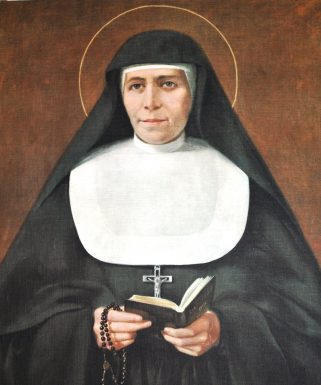
Saint Mary Mazzarello

Co-Foundress · Canonized June 24, 1951

"Our Lady will be our true Superior, and I will be her Vicar."

St. Mary Domenica Mazzarello, together with St. John Bosco, co-founded the Institute of the Daughters of Mary Help of Christians — a peasant girl from Mornese who became formator to a congregation that reached three continents in her lifetime.
In Brief

A farm girl turned dressmaker, then formator — Mazzarello’s path ran from the vineyards of Mornese to a workroom teaching poor girls to sew, to founding, alongside Don Bosco, a congregation of religious women serving young people across the world.
1837

Early Life

Mary Domenica was born into a peasant farming family on May 9, 1837 in Mornese, Italy. Gifted with uncommon good health and physical strength, she worked in the fields and vineyards with her father Joseph. At home she helped her mother Maddalena run the house and take care of the children. Her parents formed her to a profound sense of God, an upright conscience, a marked practical sense, and depth of judgment.
In 1855 she joined the Pious Union of the Daughters of Mary Immaculate, which aimed to bring God back to home and state and promote love for the Church and the Pope through frequenting the Sacraments, loving Christ in His Passion, and tender devotion to the Blessed Virgin Mary.
In 1860 typhoid fever struck Mornese. Fr. Domenico Pestarino, Mary’s confessor, suggested she care for ill relatives. She accepted, knowing she herself might fall victim — and did, recovering but losing the physical strength that farm work required. In a mysterious vision afterward she saw a large building full of girls at play, and heard a voice say to her:

1862

The Workroom

No longer able to work the fields, and under what she took as Divine Inspiration, Mary set out to learn dressmaking. She drew in her friend Petronilla, and together they opened a sewing workroom — meant to teach poor girls of the town not only to sew, but above all to love God.

In 1862 Don Pestarino met St. John Bosco and, moved by his work for abandoned boys, became a Salesian priest. Through him, Don Bosco sent Mary and Petronilla a note that reshaped their work: “Pray certainly, but do as much good as you can, especially to the young, and do all you can to prevent sin.”
Circumstances soon led the two women to take in two little girls without a stable family, caring for them like mothers. Around Carnival, with Don Bosco’s words in mind, Mary began Sunday gatherings at the workroom — games, catechism, prayer, Adoration — a festive oratory the girls loved so much they thought of nothing else all week.
In 1864, Don Bosco arrived in Mornese with a hundred boys on an autumn excursion, and approved a school for the town’s children. Watching him, Mary said simply:

1872

The Institute of the Daughters of Mary Help of Christians

Pope Pius IX urged Don Bosco to do for girls what he had done for boys. With Don Pestarino, he drew the Institute’s first members from the Daughters of the Immaculate, who would live in the newly built school in Mornese.

On August 5, 1872, the first eleven young women made their religious profession before the Bishop of Acqui, Giuseppe Sciandra, in Don Bosco’s presence. As Superior, Sister Mary Mazzarello proved a skilled formator: discerning, practically able, cheerful in a way that reassured others, and gifted at drawing young women into the work of raising good Christians and honest citizens.
In 1877, six FMA sisters left for the missions and founded the first house in Uruguay, followed within the year by houses in Argentina. In 1879 the Motherhouse moved from Mornese to the more accessible Nizza Monferrato.
At 44, Sr. Mary Mazzarello contracted severe pleurisy pneumonia and died on May 14, 1881, in Nizza Monferrato.

The Record

May 14, 1881

Died in Nizza Monferrato, age 44

November 20, 1938

Beatified

June 24, 1951

Canonized a Saint